The True Story Behind Bluebird Man: How Ordinary People Helped Bring Bluebirds Back
Beyond the story of Bluebird Man lies one of conservation’s greatest success stories. This companion article explores how bluebirds declined across North America, why simple nest boxes became an unexpectedly powerful conservation tool, and how thousands of volunteers helped reverse their fortunes. It’s a reminder that lasting environmental change is often built through small, consistent acts of stewardship carried out by ordinary people.
The Conservation Success Story We Don’t Talk About Enough
Spend enough time reading environmental news and you could be forgiven for thinking every conservation story ends the same way. A species declines. A habitat disappears. A warming climate pushes another ecosystem closer to collapse. These stories are real, urgent, and deserving of our attention. But they are only half of conservation’s history.
The other half is filled with recoveries.
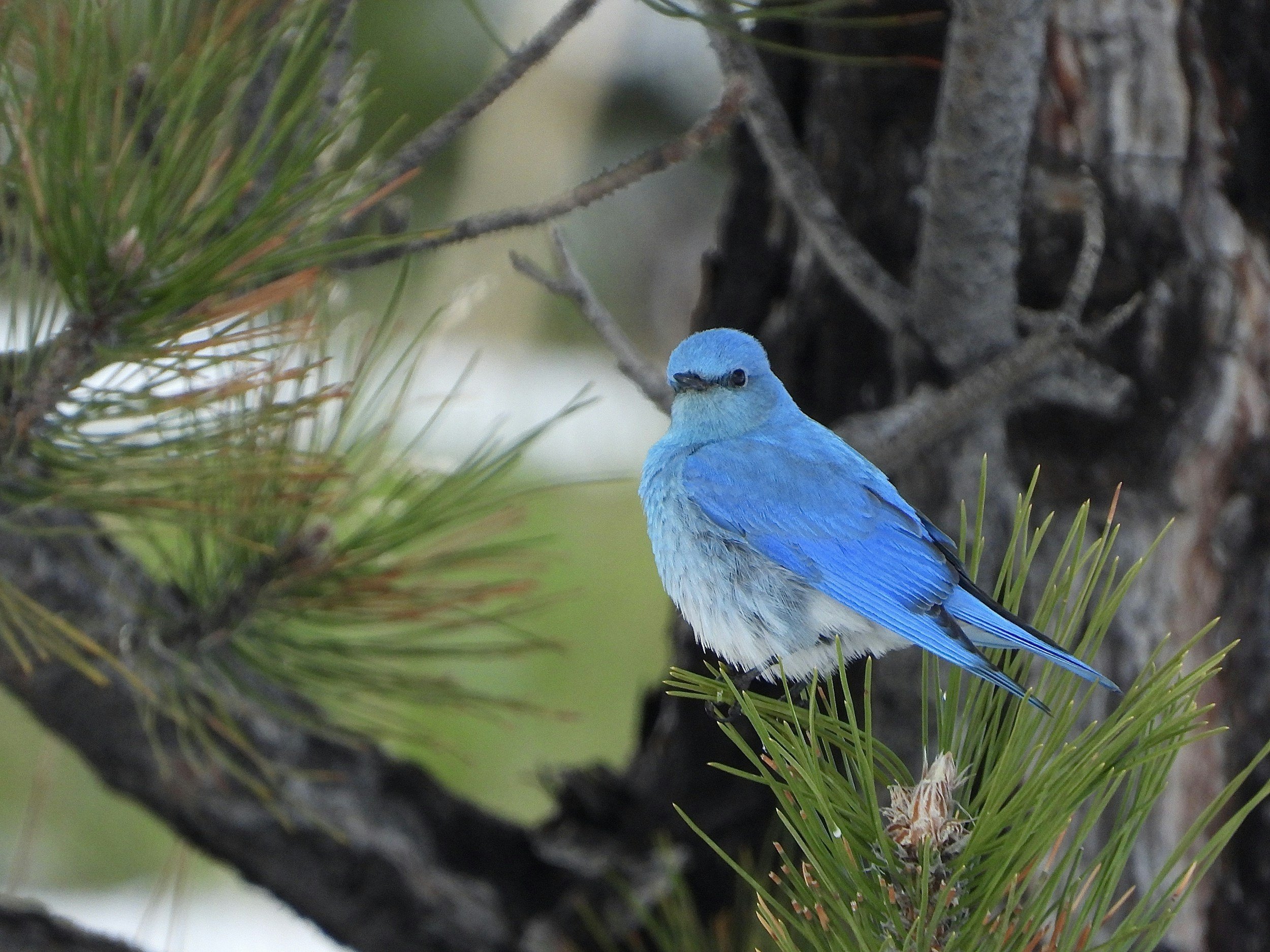
Across North America, bald eagles have returned to rivers where they once disappeared. Peregrine falcons again nest on city skyscrapers. Gray whales recovered from the brink of extinction after commercial whaling ended. One of the most remarkable recoveries, however, has happened quietly, in backyards, pastures, parks, and fence lines across the continent. It is the story of the bluebird, and it demonstrates what conservation can achieve when thousands of ordinary people decide to help.
The recovery of North America’s bluebirds did not begin with a major government program or a breakthrough scientific discovery. It began with a simple observation: bluebirds were running out of places to nest.
A home shortage
Bluebirds belong to a group of birds known as cavity nesters. Unlike robins or sparrows, they cannot build exposed nests in shrubs or tree branches. Instead, they depend on naturally occurring holes in trees, often excavated by woodpeckers or created as trees age and decay.
For thousands of years, this strategy worked remarkably well. Forests continually produced dead and dying trees, woodpeckers created fresh cavities, and bluebirds moved into abandoned nests each spring.
Human landscapes changed that equation.
As agriculture intensified and communities expanded, dead trees were routinely removed from fields, parks, and neighborhoods. Standing snags that once provided homes for birds were cut for safety or aesthetics. At the same time, two introduced species—European Starlings and House Sparrows—spread rapidly across North America. Both compete aggressively for nesting cavities, often displacing native birds before they have a chance to breed.
By the middle of the twentieth century, bluebird populations had declined dramatically across much of their range. Their brilliant colors remained an icon of spring, but in many places they had become an increasingly uncommon sight.
The simplest solution was the right one
Conservation success stories are often portrayed as technologically sophisticated, requiring expensive equipment, complex ecological models, or decades of laboratory research. Bluebird conservation succeeded through something much simpler.
People built boxes.
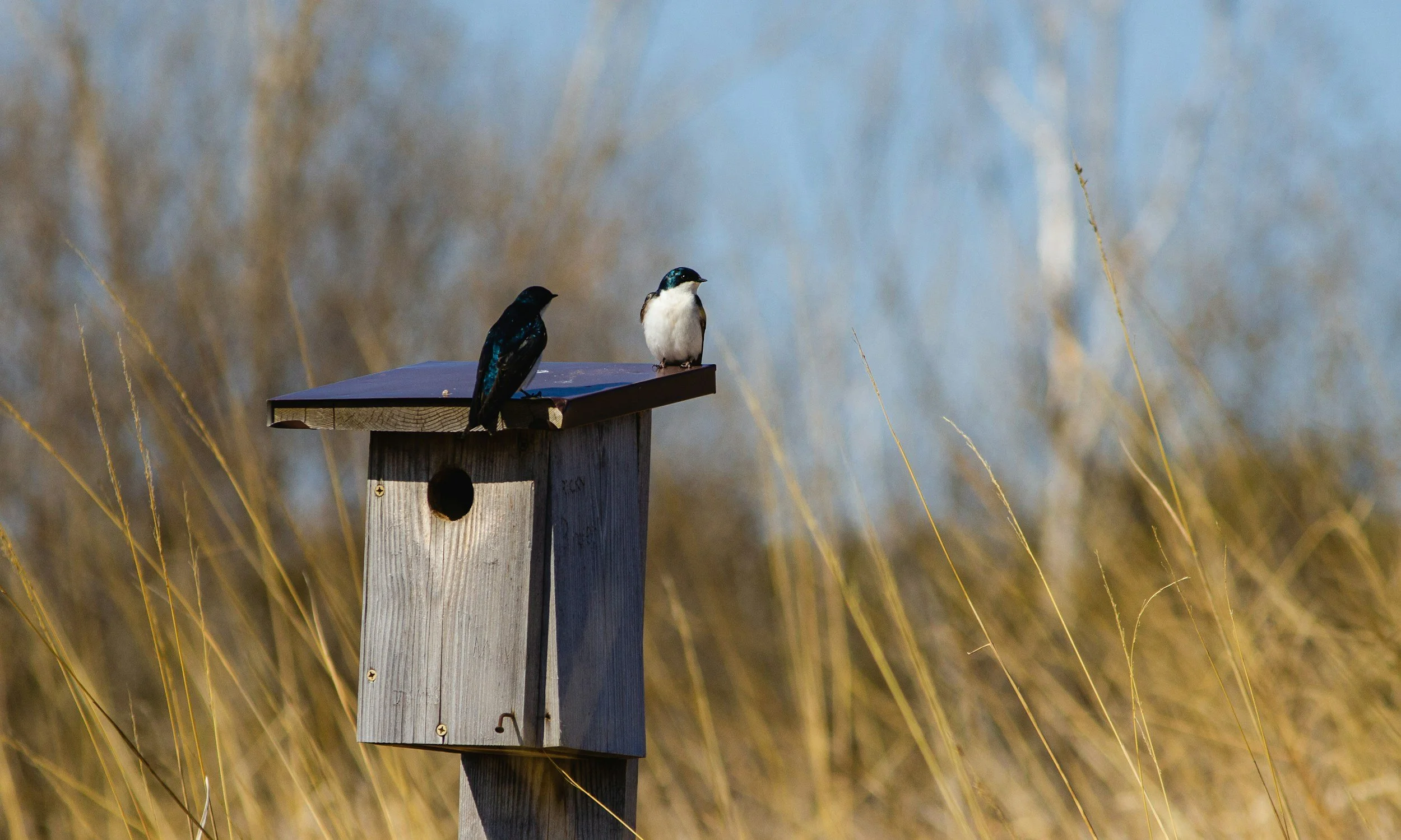
Properly designed nest boxes mimic the natural tree cavities bluebirds evolved to use. A small entrance hole excludes many larger competitors, while the enclosed chamber provides shelter from weather and predators. When placed in suitable habitat and monitored regularly, nest boxes dramatically increase breeding opportunities.
One nest box can raise a family of bluebirds.
Hundreds of nest boxes can help restore a local population.
Thousands, spread across an entire continent, can help reverse decades of decline.
The simplicity of the solution made it uniquely accessible. Anyone with basic woodworking skills—or the ability to purchase a pre-made box—could become part of the recovery. Schools built bluebird trails. Nature centers organized volunteers. Ranchers installed boxes along fence lines. Bird clubs adopted monitoring routes that stretched for miles across rural landscapes.
Conservation became something people could do with their own hands.
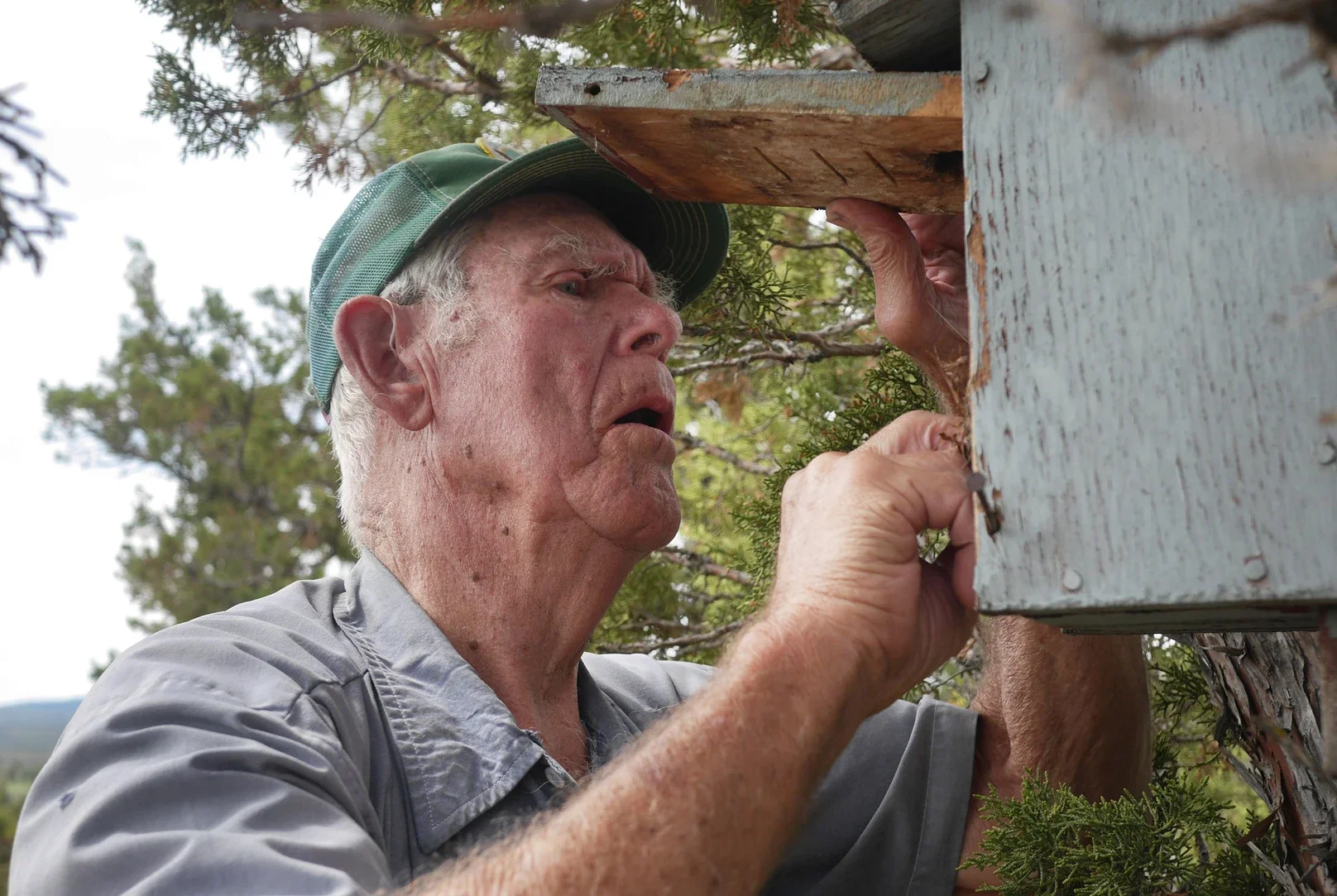
Conservation icon and documentary star Alfred Larson examines the contents of a nest box in Prairie, Idaho. Since taking up the initiative in retirement, the nonagenarian has installed hundreds of these structures, allowing scientists to study Mountain Bluebirds as the species recovers from historical declines and grapples with new uncertainties. Photo: Matthew Podolsky
Citizen science before it became a buzzword
Today, “citizen science” has become a familiar phrase. Volunteers identify birds through smartphone apps, photograph pollinators, classify galaxies online, and contribute millions of observations to global biodiversity databases.
Long before those technologies existed, bluebird monitors were already practicing citizen science.
Every nesting season, volunteers recorded when birds arrived, how many eggs were laid, how many chicks fledged, and whether nest boxes required maintenance. Individually, each observation seemed small. Collectively, they created one of the most extensive volunteer wildlife monitoring efforts in North America.
These records helped scientists understand population trends, nesting success, migration timing, and habitat quality while allowing local communities to track the success of their own conservation efforts.
Just as importantly, citizen science changed the relationship between people and nature.
Rather than observing wildlife from a distance, volunteers became participants in conservation. They learned the rhythms of a single species across years and even decades. Children who helped clean nest boxes often returned as adults to manage trails of their own. Conservation became less about witnessing environmental problems and more about taking responsibility for solving them.
Why stories like Bluebird Man matter
This is why documentaries like Bluebird Man feel so important today.
The film is not simply about one remarkable volunteer. It captures a philosophy that has shaped conservation for generations: meaningful change often begins locally, grows slowly, and depends on people who rarely seek recognition.
Environmental storytelling frequently asks audiences to understand problems measured in millions of acres, billions of tons of carbon, or thousands of endangered species. Those scales are necessary, but they can also feel overwhelming. It becomes difficult to imagine how individual actions fit into challenges so immense.
Bluebird conservation offers another perspective.
Nobody restored North America’s bluebirds alone. Instead, thousands of individuals each cared for a small piece of the puzzle. One family installed a nest box. A retiree checked a trail every weekend. A classroom monitored birds outside the schoolyard. Over time, those small commitments accumulated into one of the continent’s quiet conservation successes.
That lesson extends far beyond bluebirds.
Whether restoring prairie habitat, planting pollinator gardens, monitoring amphibians, removing invasive plants, or documenting local wildlife, conservation succeeds when communities believe that their individual efforts matter. Large environmental victories are almost always built from countless small acts of stewardship carried out by people who never expect public recognition.
Hope is evidence
Optimism in conservation is sometimes dismissed as naïve, as though hopeful stories distract from the urgency of environmental crises. In reality, the opposite is true.
Hope without evidence is wishful thinking.
Hope grounded in successful conservation is something far more powerful.
Bluebirds recovered because people identified a problem, understood its causes, and worked together over decades to solve it. That story does not diminish today’s environmental challenges. It reminds us that meaningful progress is possible when science, community, and persistence align around a common goal.
At Wild Commons, we believe these stories deserve just as much attention as stories of decline. They remind us not only what is at stake, but also what is possible.
Bluebird Man celebrates one individual whose lifetime of stewardship helped shape that success. The broader history of bluebird conservation reminds us that he was never working alone. Across North America, thousands of people have quietly built homes for bluebirds, monitored nesting seasons, and cared for the landscapes they call home.
Together, they proved something conservation sometimes forgets to say out loud: ordinary people can accomplish extraordinary things.