AI Can Create Nature Films. But Is It Still Documentary?
An AI-generated nature documentary has sparked a debate about the future of nonfiction filmmaking. But beyond questions of technology lies a more fundamental one: what makes a documentary a documentary? This essay explores the distinction between documentation and visualization, the role of lived experience in storytelling, and why lowering barriers to filmmaking should never come at the expense of observation, relationships, and trust. As AI becomes part of the documentary world, the challenge is not choosing between technology and tradition, but preserving the values that have always defined the genre.
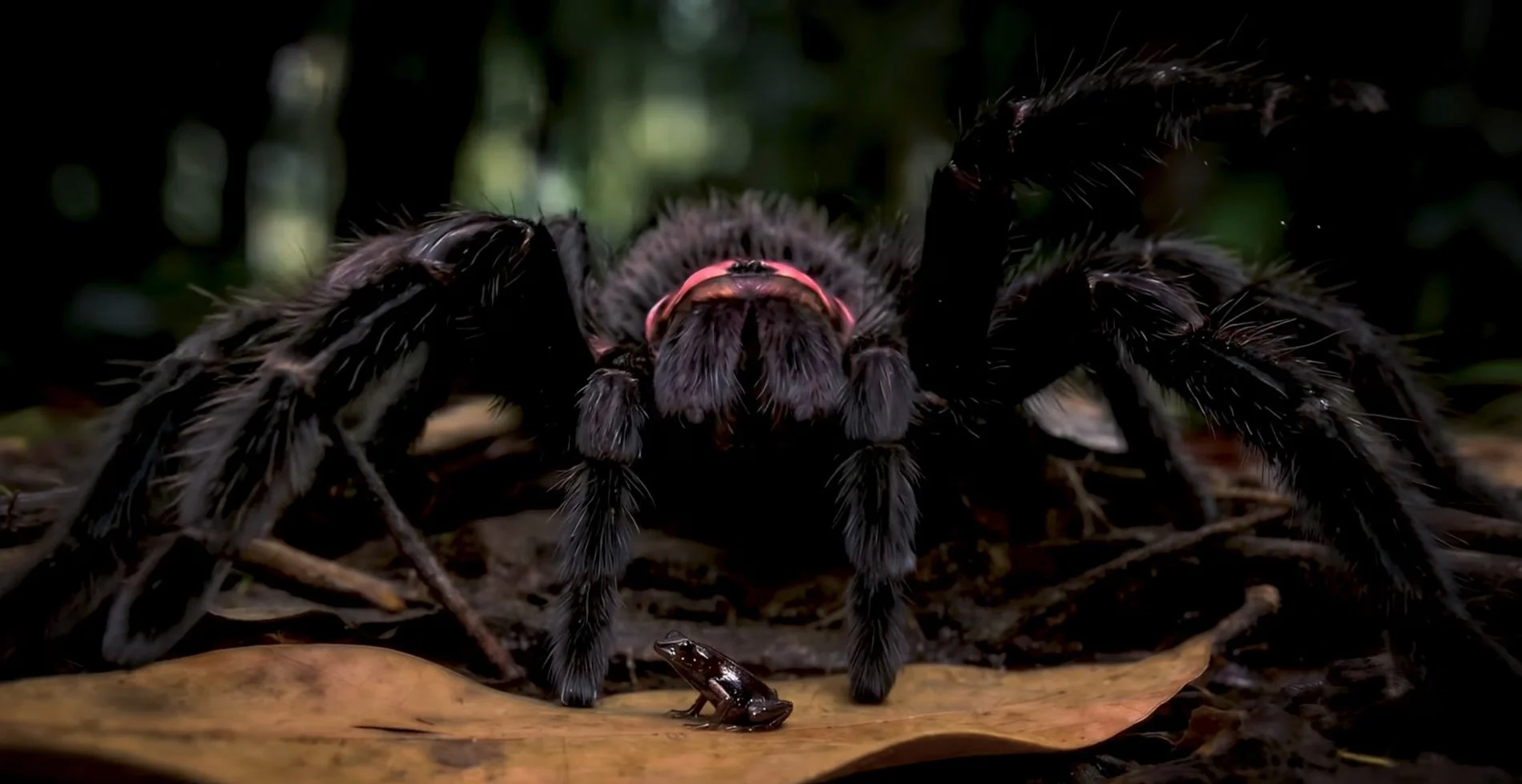
A giant tarantula protects a tiny frog in a scene from the short AI documentary Guardians of the Burrow | The Guardian
An AI-generated nature documentary has been making headlines this week.
The film imagines the hidden relationship between an Australian tarantula and a frog living together inside a burrow, a behavior that scientists believe occurs but has never been successfully filmed. Cameras placed inside the burrow would alter the animals’ behavior, making direct observation nearly impossible. The discussion that followed has been predictable. Some have celebrated the film as a breakthrough for independent filmmaking. Others have dismissed it as a threat to documentary.
Both reactions miss an opportunity to ask a more interesting question: If a film has no observer, what makes it a documentary?
At Wild Commons, we believe that documentary filmmaking needs fewer barriers to entry. Too many important films never reach audiences because production is expensive, distribution is limited, and opportunities are concentrated among a relatively small number of people and organizations. We believe more filmmakers should have the opportunity to tell stories about the natural world, and that audiences benefit when a wider range of voices are able to participate.
In that sense, AI raises questions that are closely aligned with our own. If new tools make filmmaking more accessible, reduce production costs, or allow independent creators to pursue projects that would otherwise be impossible, those are meaningful developments.
The challenge is that documentary is not only defined by the final product. It is equally defined by the process of making it.
Wildlife documentaries occupy a unique space between journalism, science, and art. They communicate ideas, but they also document encounters. Every sequence reflects decisions about where to go, how long to wait, whom to work with, and what nature ultimately reveals. The camera is more than a recording device. It is the bridge between the observer and the world they are trying to share.
That relationship shapes the story in ways that are often invisible to the audience. Time spent in a landscape changes the questions a filmmaker asks. Conversations with scientists and local communities reshape assumptions. Unexpected observations redirect the narrative.
Many of the most memorable moments in documentary exist precisely because reality refused to follow the original plan. AI changes that relationship.
In the case of this film, the filmmaker has been transparent that the imagery was generated using AI and informed by scientific research rather than direct observation. The goal was not to convince audiences that hidden cameras had captured something they had not. It was to visualize a scientific relationship that cameras could not easily record.
That distinction matters.
AI may lower barriers to filmmaking in important ways. We welcome that possibility. Documentary has long needed more voices, more perspectives, and more accessible paths into the craft. If new tools make it easier for people to tell stories about the natural world, that is something worth celebrating.
AI also removes many of the constraints of traditional wildlife filmmaking. It becomes possible to visualize behaviors that have never been filmed, reconstruct past events, or illustrate scientific hypotheses with remarkable realism. It allows for the visualization of scenes that, had they been filmed, would disturb or even harm sensitive species and ecosystems. These capabilities may become valuable tools for education and science communication, particularly when they are presented transparently.
But the question here is what defines the genre.
Documentary demands that filmmakers spend time in places, build relationships with their subjects, work alongside scientists and communities, and allow the world to shape the story they ultimately tell. Those experiences are not obstacles to overcome. They are part of what gives documentary its credibility and value. The story is not simply created. It is shaped by what the world reveals.
That may be the most important distinction raised by this film. AI can visualize scientific ideas with remarkable clarity. It can reconstruct places we cannot visit and behaviors we cannot observe.
But visualization and documentation are not the same practice. One translates knowledge into images. The other creates new knowledge through observation.
As AI tools enter the world of documentary filmmaking, perhaps the question is not whether AI belongs. It is what we hope documentary retains. The genre has always asked us to slow down, to spend time in places, and to let the world speak for itself. That commitment has shaped not only the stories we tell, but the way we come to know the natural world. As new tools expand what is possible, documentary should continue to anchor us in what is real. Not because reality is the only source of meaningful stories, but because it remains the foundation on which trust in our world is built.
Watch the doc here: